
Ins Choi’s Son of a Preacherman premiered at the Pacific Theatre in Vancouver in April 2025, then toured across Canada. The play combines poems, songs, and prayers with personal memories and reflections on race and other subjects. Now readers can enjoy the full script — which forms the first half of this book — along with “Some Bits That Didn’t Make the Final Edit.”
As the son, grandson, and nephew of preachers, Choi was expected to follow in their footsteps and become a pastor. Despite family pressure, he became a writer and performer, best known for the play that turned into the hit television show Kim’s Convenience. Choi says that his father, who founded the Toronto Korean Bethel Evangelical Church, used to work his “Sunday matinee magic” when delivering sermons. Urged on by his parents, Choi went to Bible college. After taking an introductory acting class, he switched schools to pursue theatre studies. For Choi, performing was more joyful than preaching: “I felt all my cylinders firing, plus, there was all this necessary time spent with others resulting in the natural by‑product known as friends.”
In one of his anecdotal sections, “Asian Roles and Role Models,” Choi recalls auditioning for parts in plays and on television. Roles for Asians, he remarks, were scarce. They were also generic, unflattering, and non-speaking: “Asian Gangster #4 in the background, Chinese Waiter #5 in the background, Vietnamese Band Member in the background playing for white GIs in the foreground.” Among Asian actors who achieved visibility in secondary roles, Choi comes up with a few examples, including George Takei in Star Trek and Pat Morita in Happy Days and The Karate Kid. When he was young, wanting to connect with “someone who looked like me on TV,” he idolized Ricky “The Dragon” Steamboat, the pro wrestler who sported a red bandana and white tights (a look that, for a time, Choi adopted as his own).
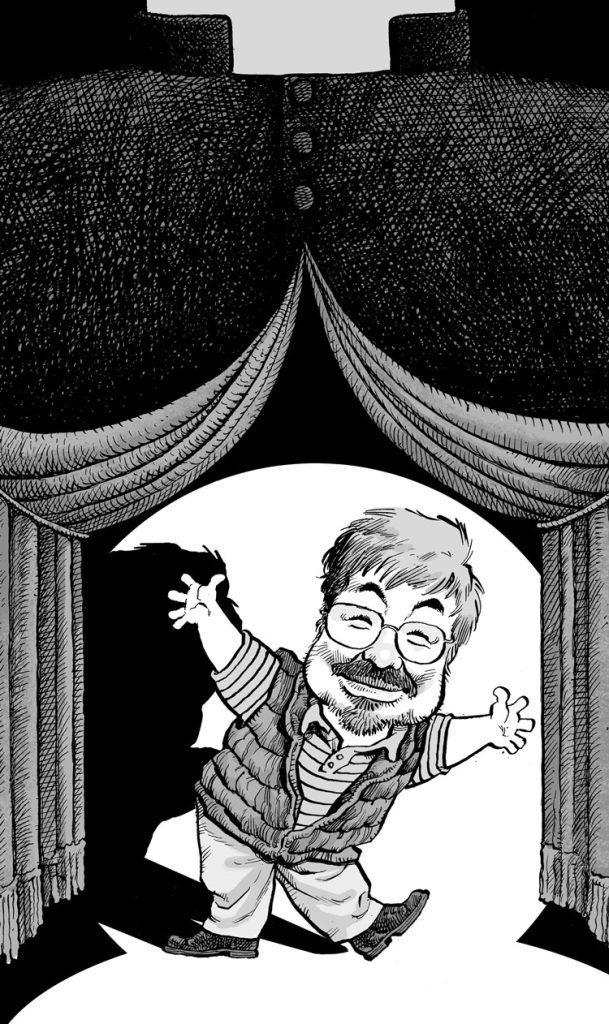
From the church to centre stage.
David Parkins
Prompted by a request from an Asian theatre company, Choi started working on the script for Kim’s Convenience. He jokes that since Kim is the most common Korean surname, “even if nobody but the Kims in Toronto came out, it would do alright.” When he sent the play around to “all the theatre companies” in Toronto, they turned it down. As a “full-time out-of-work actor,” he spent six years as a part-time children’s pastor in his father’s church. Although he resisted being a preacher, he also found meaning and solace in Christianity.
Should Choi preach or act? The two vocations turned out to have a lot in common. When Choi’s father addressed a congregation, he transformed his sermon from a bunch of messy notes on a page “into a holy voice crying in the urban wilderness — a healing balm for the restless soul.” Son of a Preacherman does something similar. In some songs, Choi addresses God and comments directly on Biblical passages. Jesus even visits him in a dream and flicks him on the forehead to steer him onto the path of acting and writing. If that’s what he’s good at, Jesus tells him, “then go and do that. (flick).”
If Jesus were around today, what would his favourite films be? Babette’s Feast? Jesus of Montreal? Movie references pepper the script. Choi relates personal experiences to moments in Raiders of the Lost Ark, Tommy Boy, and Contact. Instead of reading The Outsiders, S. E. Hinton’s coming-of-age novel, for a high school class, he watched the Francis Ford Coppola adaptation. Although the comparison might not occur to everyone, Choi draws an analogy between The Flintstones and Ecclesiastes. Both are about rocks: “A time to cast away stones, and a time to gather stones.” In one of the funnier lines in the book, a biographical note states that Choi lives in Toronto with his wife “and their two screenagers.”
Certainly the most ebullient sections of Son of a Preacherman are the songs, many of which have catchy rhythms and turns of phrase. Some use traditional ballad metre, although they are not lineated to look like poems. Others are inspired by rap, with rhymes making unexpected phonetic patterns:
We’re all born into this world grasping
Clasping tightly fisted
Knuckles twisted
Clutching clenching clinching
Inching for a taste in this insatiable race
The last song in the book, “Joy,” is an exuberant riff on the diphthong “oy”: boy, soy, toy, Troy, decoy, envoy, destroy, goy, ahoy, corduroy, cowboy, Tolstoy, Rob Roy, Christian Hosoi, alloy, ploy, and, in case it needs repeating, Choi.
In the end, this one-man show is about friendship. Choi often mentions how much he wants to make friends. As a youngster, he longed to be Bruce Lee’s best bud in Enter the Dragon. His parents forced him to make nice with new kids at church, which would have been okay if the new kids wanted to be friends with him — not always a given. While still in high school, he succumbed to a sense of defeat on several fronts, or so he felt at the time: “I failed as an Asian, didn’t know kung fu, had no friends, didn’t get good marks.” Theatre is a meeting place for the like-minded, a place where friendships are waiting to happen.
Son of a Preacherman runs about seventy-five minutes without intermission. It could be longer and not lose either its impact or its humour. Among the sixteen bits cut from the final edit, at least two could easily fit into the play text to enhance the content. “Please God” is a lengthy, warm-hearted reflection on failing a chemistry test and how prayer may or may not reveal Choi’s destiny. “Joy,” closing the volume, brims with jubilance.
Choi acknowledges that “words on a page can’t replicate the feeling of a room full of people laughing and crying together.” In a printed text, there are no lights, no music, no actors, and no audience. In the absence of those elements, the words home in on Choi’s voice as a medium for a story about finding his way from being a kid who watches a lot of TV to becoming a successful playwright and actor. The wisdom of this play is a secret known to those who studied the humanities without knowing where their training would lead: “What you do is immensely appreciated by your future self.” All the detours and backfires along the way are necessary steps in figuring out what your talents are and how best to use them.
Allan Hepburn is the James McGill Professor of Twentieth-Century Literature at McGill University.
Advertisement

Advertisement