
In 2007, Nicolas Sarkozy, the newly elected French president, scandalized his country’s intelligentsia by going jogging. To Alain Finkielkraut, a public intellectual and television talk-show host, for a head of state to engage in such unseemly exertions signalled societal decline. “Western civilization, in its best sense, was born with the promenade,” he said. “Walking is a sensitive, spiritual act. Jogging is management of the body.” And Finkielkraut was far from the only writer for whom Sarkozy’s exercising carried a faintly ignoble whiff. The left-wing newspaper Libération suggested, only half jokingly, that the ethos of optimization, performance, and individualism associated with fitness culture is inherently — gasp — American.
The clamour extended a long tradition of romanticizing walking. From Rousseau, Wordsworth, and Thoreau to contemporary wellness influencers, people have long cast walking as an antidote to the bustle and regimentation of modernity. To amble, say the promoters of pedestrianism, is to momentarily slow our harried lives, to attune ourselves to an inner voice, a more authentic self that is suppressed by our culture of instantaneity, overwork, and hypermediation. For Aristotle and Nietzsche, walking was a vital catalyst of good thinking. It “articulates,” according to Rebecca Solnit, “physical and mental freedom.” And the science bears these sentiments out. A 2014 study, for instance, found that walking — and especially outdoor walking — boosts creativity.
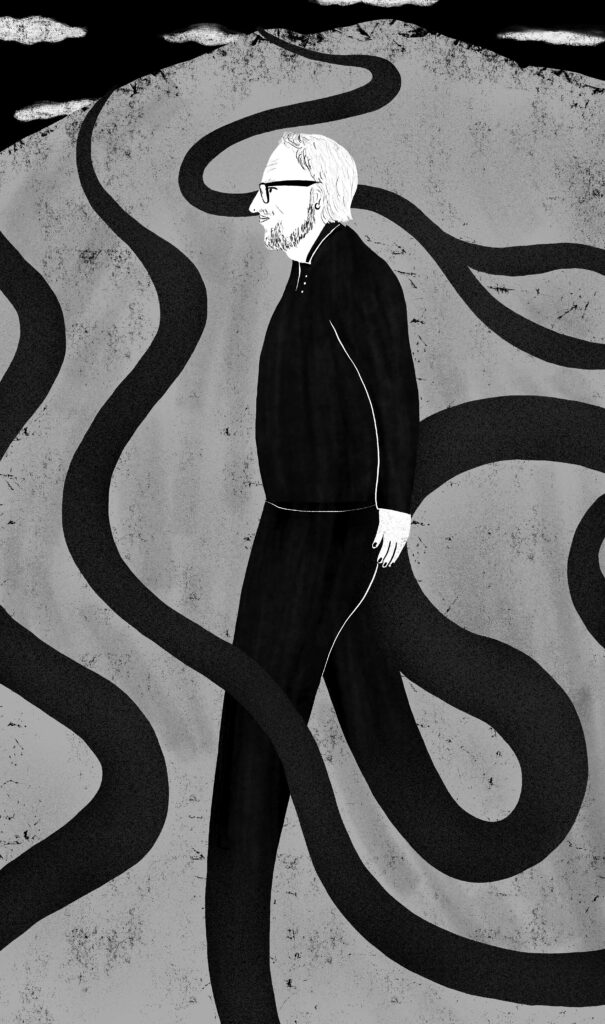
Oh, the places we amble!
Natàlia Pàmies Lluís
All this advocacy for walking presumes a particular type of locomotion: no Monty Python Ministry of Silly Walks here nor big-city speed-walkers who zip along narrow downtown sidewalks, silently cursing the shambling masses. But I’d argue that COVID‑19 temporarily levelled out some of these differences. During the strictest lockdowns, leisurely strolls became one of our few viable activities outside the home. With restaurants, bars, theatres, and gyms closed and so much of our time spent staring into screens, the neighbourhood constitutional, whether solo or as a form of socializing, became a veritable event. I’d wager that for many busy adults, it was hard to recall a moment when we’d been so self-consciously aware of the simple act of walking, an activity that is often an afterthought in our daily lives, a mere way to get from one place to another, a means to some other end.
The pandemic years remain our recent past. To me, though, they feel as surreally detached from the present as the prospect of a restored world did in those days under quarantine. Two recent books return us to that time of upheaval, depicting the lockdown-era walk as something more than a mere physical act. Instead, they present walking as a conduit for a rich range of thought and social observation — whether on political economy, regional history, and reconciliation or on aging, friendship, and art.
Ken Wilson’s walking is solo. In Walking the Bypass: Notes on Place from the Side of the Road, he recounts a series of long-distance treks along the Regina Bypass, built in 2019 as a partial ring road connecting the Trans-Canada Highway to Highway 11. For most, these walks will seem stunning — or perhaps mystifying — feats of masochism. The Regina Bypass is expressly not built for pedestrians; with each walk along its unprotected shoulder, Wilson takes his chances, as vehicles roar narrowly past. The road he walks is flat, grey, and unvarying; the surrounding landscape mostly monotonous grids of commercial-scale farming; and the weather often punishing. Wilson, in his late fifties and by his own admission distinctly unathletic, is hardly the ideal candidate for such rigours.
Why put oneself through this? Wilson, an assistant professor in the University of Regina’s English department and recipient of the 2022 City of Regina Writing Award for the manuscript version of this book, casts his plodding as an experiential and artistic experiment. He calls his walks “improvised pilgrimages,” borrowing a phrase from the writer Robert Macfarlane, and he hopes they might leave him more deeply attuned to the land, awakened to a “numinous quality” that rampant construction, commercialization, and wide-ranging environmental degradation threaten to extinguish. Each of his journeys enacts this quest, but Wilson also walks with two definite destinations in mind. One — the most crucial to his itinerary — is the cemetery of the Regina Indian Industrial School, whose dark legacies, Wilson observes, we have yet to fathom. The other is the Global Transportation Hub, a vast shipping and warehouse depot on Regina’s fringe. Politicians have promised that the GTH will juice up the local economy, placing Saskatchewan at the centre of continental logistics networks. Its existence is, in fact, the main reason for building the bypass in the first place.
For Wilson, each site serves as an emblem of larger social forces that sever possibilities for human community anchored in a bond to the earth. The cemetery exemplifies a residential school system that was “intended to break the children’s connection to the land, to eradicate their languages and cultures.” It ultimately bespeaks what Wilson calls a strategy to eliminate any Indigenous claim to territory. The GTH, meanwhile, exists to lubricate an economy whose ecological ravages are growing ever clearer with each new flood, forest fire, or Intergovernmental Panel on Climate Change report. Each is thus a site of despoliation. And the force that despoils both is, Wilson argues, settler colonialism, a central concept of his book. The land that Wilson walks entombs destroyed lives and the cultures they would have sustained as well as the riotous, diverse ecological formations snuffed out by the rise of commercialized farming and its homogeneous crops. Wilson’s method is to peel back the historical layers of the landscapes he traverses, searching for bygone futures, alternative forms of living that never came to pass.
Walking the Bypass sings in Wilson’s descriptions of his treks, which are often entrancing, as well as in its histories of Crown-Indigenous relations. Wilson’s vivid accounts of treaty negotiations, especially, reveal pervasive bad faith, chicanery, and misunderstanding. “Could the negotiating parties have understood each other, given their different cultural and legal frameworks?” he asks. “It seems unlikely.” Questioning the legitimacy and fairness of those negotiations — especially on Treaty 4 in September 1874 — Wilson opens space for imagining anew what is owed to those the Crown dispossessed. Is reconciliation, he asks, enough? Morally defensible Indigenous-settler relations might rather be predicated on notions like atonement or intergenerational responsibility. Here Wilson invokes wide-ranging philosophical and literary discussions of recent decades about the degree to which those who benefit from injustices they themselves did not commit remain complicit and responsible for that harm.
While Walking the Bypass broaches these thorny problems, it does not offer firm solutions. (To be fair, there aren’t obvious ones.) Likewise, many of the book’s musings on prospects for renewing relations with the land unfold on the plane of theory and abstraction. Concrete proposals are often at most implied, not stated. What Wilson voices clearly across the book is a deep sense of obligation for the devastation wreaked upon the land and Indigenous people by the system of which he is a beneficiary. Justified by both history and morality, his expressions of remorse are no doubt heartfelt. However, they recur so often in Walking the Bypass that they begin to sound almost rote, a penitential chant of progressive orthodoxies rather than the serious appeal for civilizational reckoning that Wilson intends. Push aside the repetition, though, and what remains is something more than a searching cultural geography of place. It’s a book that uses the regional to unfold and to grapple with some of the most vital challenges of our time.
Wilson tells us early on that his book is the outgrowth of a “research-creation” doctorate, a work of “scholarship that incorporates an artistic or creative component.” It’s also an example of what the literary critic Andrew Epstein has called an “everyday-life project,” an “artificial, rule-bound, performative” experiment in which a person records their experience while carrying out specific activities. The art these experiments yield springs in large part from the keen awareness directed by the subject toward ordinary experience. Almost sacramentally, through heightened attention, the artist makes the ordinary extraordinary. This form of project art has exploded in popularity in recent decades — a response, Epstein argues, to an age of distraction.
The sort of contemplative, generous attentiveness associated with an everyday-life project suffuses Merilyn Simonds’s Walking with Beth: Conversations with My Hundred-Year-Old Friend. Really, that’s part of what makes the book such a delight to read. Simonds, a Governor General’s Award finalist for The Convict Lover, recounts three years of her friendship with Beth Robinson, a former professor of art therapy. Theirs is an intergenerational bond — Simonds is in her early seventies, Robinson three decades older — and the period Simonds documents is of the lockdowns, which restricted the pair’s in‑person socializing largely to outdoor strolls, backyard meals, and tea on benches looking out upon Lake Ontario from Kingston, where the two live.
The years separating them became the foundation for Simonds’s literary experiment. Simonds has always been captivated by older women, she tells us, whether as a biographer or in everyday life. Their experiences illuminate, if only imperfectly, some of what awaits the young. And in particular, single women living alone — many widowed, like Robinson — especially catch Simonds’s interest. Across her life, they’ve been models of candour, self-reliance, calm, and good living. Now, though, Simonds feels newly disoriented, bereft of guidance. Not only do few people make it for decades past Simonds’s age, but our culture stubbornly casts the eighties, nineties, and beyond as a mere denouement to life’s main drama. Yet individual lives defy societal models. “I’m seventy-one,” Simonds tells Beth as she hatches the idea for her book. “I feel I am entering a new stage, although I’m not sure exactly what it is. You’re almost a hundred and one; you’ve been moving through this landscape for thirty years.”
Because Simonds listens attentively to Robinson in the same way Robinson does to others, her book gives unusual texture to a stage of life often disregarded or stereotyped. “Now that I have reached my biblical threescore and ten,” she laments, “I find few books to guide me through this new territory.” Gracefully, unobtrusively, Simonds weaves in a wide array of thought about aging, including the words of Aristotle, Hokusai, May Sarton, and Jean Rhys, as well as observations on Mexican culture’s traditional three forms of death. But these models at turns merely enrich or contrast with Robinson’s embrace of ceaseless change through artistic questing. It’s impossible not to be dazzled by the sheer range of Robinson’s creative work across the decades, by her sense of the possibilities for beauty in even the most ordinary materials. She dreams up new, inventive projects, testing unfamiliar materials and techniques. And although these friends have distinct personalities, they seem kindred spirits in this regard. Each finds sustenance in beautiful objects, literary and otherwise, while also creating them. The depth of their friendship comes through quietly but powerfully in Simonds’s many descriptions of the items — gifts, clothes, food — each brings for the other when they meet. Although the items themselves are often captivating, it’s the thoughtfulness behind the selections that marks these friends’ devotion.
While Robinson lights a path for Simonds into the unmapped country of old age, this book also charts the sadness and loss that shadow her life. Two of her three children have died, as has her husband. As anyone who has experienced loss knows, it’s not at all the case that what doesn’t kill you makes you stronger, and some of the most moving passages are those in which Robinson grapples with the absence of those she’d believed would outlive her. Simonds, whose own health falters as the pages unfold, confronts mortality even while worrying over Robinson’s vulnerability to COVID‑19. And this pained awareness of transience shapes Simonds’s descriptions of the many homes, objects, and people that pass through a typical human life, transitory companions preserved only in memory. Walking with Beth’s very structure — a collection of brief, fragmentary chapters — bolsters this sense of fleetingness.
Early on, Robinson and Simonds discuss the “swan-song phenomenon,” in which an artist produces one last triumphant work as they near life’s end. To many, this jars against ingrained cultural associations of youth with achievement and old age with decline. But as Walking with Beth shows, many artists have bucked those expectations. Maybe energy and stamina falter with the passing years, but mastery of craft often deepens with practice. Simonds senses that her own future no longer lies stretched out endlessly before her, yet decades more may well await. Walking with Beth is not a swan song, but in its lively, crystalline prose and acute psychological vision, it’s the unmistakable product of a writer who has spent decades honing her gifts. While it will especially appeal to those navigating or approaching old age, the pleasures it offers — namely, acquainting oneself with two remarkable people as they grapple with some of life’s fundamental challenges — can be relished by any lover of good books.
It is also very much a collaborative project. While Robinson’s voice is mediated by Simonds’s throughout, we learn that Simonds shared drafts with her friend, who commented until each part “sits right with us both.” We might recall that our long cultural tradition of romanticizing walking largely focuses on solo strolls. The thoughtfulness that walking is often said to provoke graces a single mind. But walking together has its unique rewards.
The phrase “social synchrony” describes our innate tendency to coordinate our actions with others near us — for instance, when we fall into the rhythm of someone who walks alongside us. Wilson’s book calls for a form of social synchrony on a grand political scale, while Simonds’s models it at the level of the interpersonal. In each, walking in a time of pandemic has opened imaginative possibilities that most of us in our masks back then hardly grasped.
Spencer Morrison is a literature professor at the University of Groningen, in the Netherlands.
Advertisement
Advertisement