
The Literary Review of Canada

Happy anniversary to us! This past December, the LRC turned 20.

Get free email updates!

Magazine Issue ›› December 2009

Editor's Note

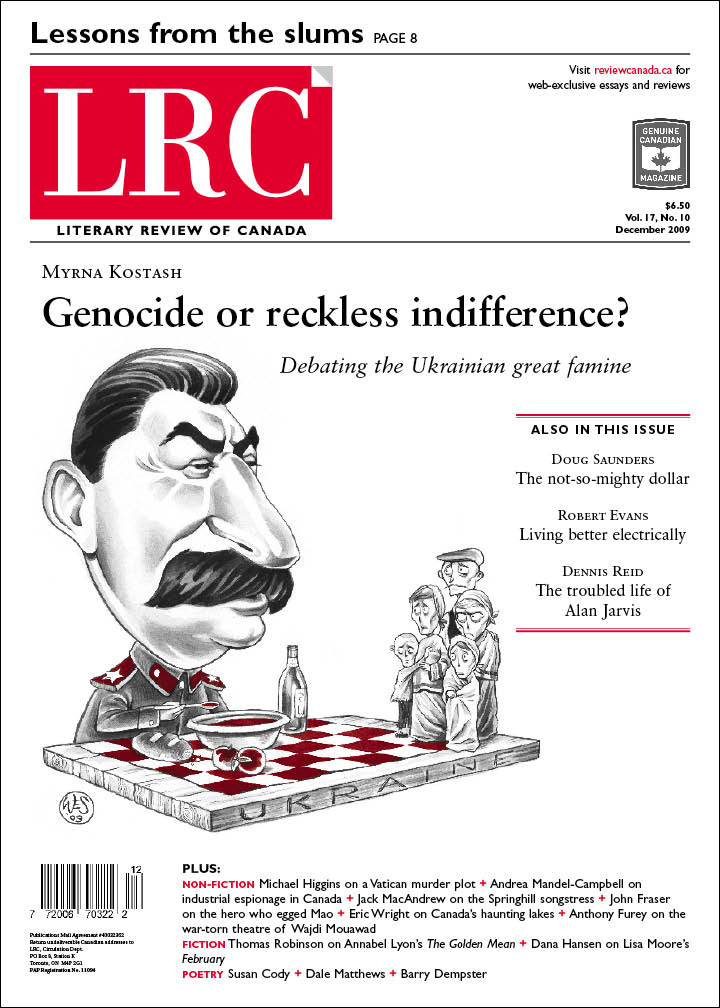
Was it genocide or reckless indifference? That’s the question a group of Alberta university students was asked to grapple with in relation to the Holodomor, the desperate famine in the 1930s that killed somewhere between 3.5 million and 7 million Ukrainians during Stalin’s rule. Award-winning author Myrna Kostash audited that course and has produced a thought-provking essay about the nature of information, memory and historical inquiry. The answer to the question the seminar was considering may surprise you.

For most of our lives, the American greenback has been the world’s reserve currency, the ballast that keeps all nations’ finances afloat. But is that likely to continue, or through withdrawal of international confidence is the dollar about to be swamped by the euro, the yuan, gold or the esoteric Special Drawing Rights, a creation of the IMF? The Globe and Mail’s European Bureau Chief, Doug Saunders, tackles this momentous possibility in his incisive review of The Future of the Dollar, a collection of essays edited by political economists Eric Helleiner of Canada and Jonathan Kirschner of the United States.

While the world gathers in Copenhagen this month to make post-Kyoto commitments to halt or at least slow down climate change, Robert L. Evans (author of Fueling Our Future: An Introduction to Sustainable Energy) lays down a set of what he calls “real world solutions” that go beyond rhetoric and hollow promises. His focus on electricity – mainly in the form of battery-powered vehicles and domestic heat pumps to replace oil and gas furnaces – provides the kind of on-the-ground analysis that has been sorely lacking from our environmental debates.

Season’s Greetings to all our readers,

Bronwyn Drainie

In the December 2009 Issue

  • The Not-So-Mighty Dollar

    A review of Eric Helleiner and Jonathan Kirschner's The Future of the Dollar

    Doug Saunders
  • Genocide or "A Vast Tragedy"?

    University students in an Alberta classroom try to decide.

    Myrna Kostash
  • Rewiring Our Future

    Fighting climate change with electric power

    Robert Evans
  • A Watery Reading of the Land

    A review of Lakeland: Journeys into the Soul of Canada, by Allan Casey

    Eric Wright
  • Spies Among Us

    A review of Nest of Spies: The Startling Truth about Foreign Agents at Work within Canada’s Borders, by Fabrice de Pierrebourg and Michel Juneau-Katsuya, translated by Ray Conlogue

    Andrea Mandel-Campbell
  • Success in the Slums?

    A review of Welcome to the Urban Revolution: How Cities Are Changing the World, by Jeb Brugmann

    Salem Alaton
  • Humanist Conspiracy

    A review of A Sudden Terror: The Plot to Murder the Pope in Renaissance Rome, by Anthony F. D’Elia

    Michael W. Higgins
  • Haunted Legacy

    A review of Wajdi Mouawad’s Tideline, translated by Shelley Tepperman, and Scorched, translated by Linda Gaboriau

    Anthony Furey
  • Porridge and Ice

    Susan Cody
  • Lobsters

    Dale Matthews
  • Christmas Spirit

    Barry Dempster
  • Grief Transformed

    A review of February, by Lisa Moore

    Dana Hansen
  • Classical Genius

    A review of The Golden Mean, by Annabel Lyon

    Thomas M. Robinson
  • The Snowbird's Story

    A review of All of Me, by Anne Murray, with Michael Posner

    Jack MacAndrew
  • Why Did He Do It?

    A review of , by Denise Chong

    John Fraser
  • Troubled Brilliance

    A review of Bringing Art to Life: A Biography of Alan Jarvis, by Andrew Horrall

    Dennis Reid
  • Letters and Responses

    John English, Richard Gwyn, Michael B. Decter, Allan Fox, James Tully, Geoff Hamilton, and Michael Valpy
  • Cover art and pictures throughout the issue by Wes Tyrell

    Wes Tyrell is a freelance illustrator and cartoonist. Prior to his life as a freelancer, he ran a hotel in Cuba and is currently writing about these bizarre experiences in a graphic novel, Fidel & I. Wes has drawn for Maclean’s, The Globe and Mail, Dogs in Canada and the BBC. Contact Wes at www.westyrell.com.

Letters for December 2009

  • Re: “Genocide or ‘A Vast Tragedy’?” by Myrna Kostash

    I found Ms. Kostash’s essay interesting and thought provoking. It certainly challenges common diaspora thinking of the Famine in Ukraine.

    Discussion of the Famine in Ukraine raises interesting issues. Some who present the case to view the Famine as a genocide use language that blames Communists, Russians, and other groups for the tragedy. At times, the language of blame drowns out the sympathy for those that died tragically. There are calls for justice to be meted out to still-living perpetrators or supporters of the ancien régime. For them, framing the events of the famine as genocide is important.

    Discussion of the famine even entered the politics of the Toronto school board’s planning of the curriculum on genocide. Those of Ukrainian descent were asked to lobby the Toronto District School Board to include the Ukrainian Famine as one of the examples of genocide in its genocide curriculum. The latter focussed on the Armenian genocide, the Holocaust and the Rwandan genocide. Some Ukrainians felt that the 1932-33 famine should have been included. Ukrainians felt left out. It is self-evident that it is not possible to study all “genocides” in detail. If the model of study includes analysis of examples in detail, then some will be studied more than others.

    This of course presumes that those that consider which “genocides” to study accept the famine as genocide.

    At the end of the day, a tragedy took place. Many people died. It is important to honour the memory of all those that died so tragically. If it is possible to prevent such tragedies, it is important to try. As to the question of whether the events reflected a “genocide or vast tragedy,” more knowledgable people than I are debating this question. Ms. Kostash was brave in posing the question.

    J.M. Szul
    Toronto, Ontario

  • Re: “Genocide or ‘A Vast Tragedy’?” by Myrna Kostash

    What is troubling about Myrna Kostash’s essay on the Holodomor is that it gives credence to the scribblings of a pro-Soviet apologist such as Doug Tottle, akin to offering up Ernst Zundel’s screeds as fair commentary on the Holocaust. Simultaneously her piece and the course she describes both fail to take into account the perspective of Dr. Raphael Lemkin, the father of the United Nations genocide convention. In 1953 Lemkin wrote: “the Ukrainian is not and never has been a Russian. His culture, his temperament, his language, his religion, are all different … to eliminate [Ukrainian] nationalism … the Ukrainian peasantry was sacrificed … a famine was necessary for the Soviet and so they got one to order … if the Soviet program succeeds completely, if the intelligentsia, the priest, and the peasant can be elim- inated [then] Ukraine will be as dead as if every Ukrainian were killed, for it will have lost that part of it which has kept and developed its culture, its beliefs, its common ideas, which have guided it and given it a soul, which, in short, made it a nation … This is not simply a case of mass murder. It is a case of genocide, of the destruction, not of individuals only, but of a culture and a nation.”

    While it is important for undergraduate students to consider controversial issues without fear of reprisal, having them “vote” on whether the Holodomor was genocidal is sophomoric and morally repugnant. As for the contemporary Holodomor deniers and their enablers cited by Kostash and approvingly introduced by John-Paul Himka, their philistine musings pale in significance when compared to the far more insightful perspective of the man who actually gave the world the term “genocide.”

    We’ll stick with Lemkin’s finding that the Great Famine—the Holodomor—was an act of genocide.

    Paul Grod
    President, Ukrainian Canadian Congress
    Winnipeg, Manitoba

  • Re: “Genocide or ‘A Vast Tragedy’?” by Myrna Kostash

    Myrna Kostash poses the question of whether to interpret the Great Famine of 1932–33 as “Genocide or ‘A Vast Tragedy’?” In examining this important question, it is fruitful to consider the views of the person who developed the concept and coined the term “genocide.” As such, Raphael Lemkin is considered the intellectual father of the 1948 United Nations Convention on Genocide. In the 1950s he had written but not published a “History of Genocide.” In this work he devotes a chapter to “Soviet Genocide in the Ukraine.” He argues that the decimation of the Ukrainian national elites, the destruction of the Ukrainian Orthodox Church, the starvation of the Ukrainian farming population and its replacement with non-Ukrainians from Russia are integral components of the same genocidal process.

    A similar line of argument has been adopted by Andrea Graziosi of the University of Naples, widely recognized as a leading international expert on the Stalin era. In a lecture last November at the Canadian Institute of Ukrainian Studies, Graziosi placed the Ukrainian famine within the larger context of general Soviet policies and famines. However, he also identified some particular measures taken against the peasantry in Ukraine and the Kuban region (inhabited largely by Ukrainians) that led to an exceptionally large number of deaths there. These included the confiscation of private food stocks and a decree forbidding and preventing peasants from Ukraine and the Kuban from leaving for other areas of the USSR in search of food.

    Graziosi also pointed to the following measures taken against Ukrainians in this period or immediately afterward: the persecution and physical destruction of the republic’s nationally conscious intelligentsia and middle-level national cadres, the reversal of a policy that favoured Ukrainian language and culture in Ukraine and the total abolition of that policy in Russia, and the mass purge of the Bolshevik Party in Soviet Ukraine. All these factors, as well as other special measures taken against Ukraine’s peasantry and its political and cultural elites, have prompted Graziosi to conclude that the 1932–33 Ukrainian-Kuban famine fits the definition of genocide specified in the UN Convention on the Prevention and Punishment of the Crime of Genocide, especially article 2, section C, which states that among genocidal acts are those “deliberately inflicting on the group conditions of life calculated to bring about its physical destruction in whole or in part.”

    Zenon E. Kohut
    Director, Canadian Institute of Ukrainian Studies
    University of Alberta
    Edmonton, Alberta

  • Re: “Genocide or ‘A Vast Tragedy’?” by Myrna Kostash

    The responses in the January/February issue of the LRC to Myrna Kostash’s December article on my seminar on the Ukrainian famine raise questions of balance and intellectual honesty.

    Zenon Kohut recommends Andrea Graziosi’s arguments for considering the famine genocide. Graziosi originally made his case in a conference paper presented in 2005, and in fact that paper was assigned reading in our seminar, as were several other important texts for genocide. I wanted students, besides learning about the famine, to see how complex historical events generate a variety of interpretations and to reflect on the methodological implications of such diversity.

    That is why I also included Doug Tottle’s pro-Soviet text written to undermine the campaign North American Ukrainians undertook in the 1980s to increase awareness about the famine. The students recognized immediately how tendentious Tottle’s book was, and it gave them an insight into the intellectual underpinnings of Soviet-style famine denial.

    The rhetoric in Tottle’s “scribblings” is very similar in tone to that employed by Paul Grod in his response. It bothers Grod that when discussing the genocide issue we took a straw vote. Declaring positions is a useful and widespread pedagogical device, but for Grod it becomes something “sophomoric and morally repugnant.” What really disturbs Grod is people discussing and thinking about the famine instead of adopting uncritically a single interpretation.

    Both Grod and Kohut appeal to the authority of Raphael Lemkin, who invented the genocide concept. They omit, however, the relevant context of how Lemkin’s views evolved. Lemkin did not consider the Ukrainian case to be genocide in 1948 when he worked out his definition for the genocide convention. That only came later, when he inflated the concept to include all communist crimes, including the deportations of Lithuanians in 1940 and the suppression of the Hungarian uprising in 1956. Another part of the story of Lemkin’s evolution is his financial dependence in the early 1950s on émigré Ukrainian and Lithuanian anticommunist groups.

    Grod says I approvingly introduced “contemporary Holodomor deniers and their enablers.” The only substantive text I could find in English that could be classified as famine denial was Tottle’s. Grod must have in mind other texts that do not deny the famine, its horrors or its human-made character but do not classify it as genocide. That is indeed the majority view in Soviet studies in the West. Most scholars studying the same evidence as Graziosi conclude that the famine was not a genocide. They think the genocide proponents insufficiently recognize the immense damage inflicted on agriculture by collectivization and the incidence of famine among Russians, especially Don Cossacks.

    The genocidal interpretation of the famine is rooted in nationalist politics seeking to portray one’s own nation as innocent victim and other nations as criminal perpetrators. There is no reason for the Ukrainian community or Ukrainian studies to remain locked into this mindset. It is better if scholars and intellectuals complicate and challenge the nationalist mythologies of their communities, not enlist as their apologists.

    John-Paul Himka
    University of Alberta
    Edmonton, Alberta

  • Re: “Haunted Legacy” by Anthony Furey

    In making “the two seminal works” of Canadian theatre The Farm Show and Leaving Home in 1972, Furey gives a Toronto-centred view. The seminal works, arguably, were earlier and elsewhere: George Ryga’s The Ecstasy of Rita Joe in Vancouver in 1967 and Michel Tremblay’s Les Belles-Sœurs in Montreal in 1968.

    I have, however, two larger complaints. First, a review of this length should comment on the quality of the translations. Is Wajdi Mouawad accurately represented in the two long quotations? We are just beginning to ask, for example, whether English speakers received the best possible sense of Tremblay’s earlier plays through the transla- tions of John Van Burek. Second, Furey evaluates Mouawad’s works solely as literary texts and not also as performance, and indeed gives no sign of having seen the two plays performed. I think of the visual impact of King Arthur’s knight waving a sword as he strides on stage in Tideline, set in the present. Or the role of the audience in that drama when characters look out at us and see a river, while saying that they are imagining the audience.

    Go to the theatre, please, Anthony Furey.

    Malcolm Page

The LRC welcomes letters. We reserve the right to publish such letters and edit them for length, clarity and accuracy. E-mail editor[at]lrcreview[dot]com.

Online Originals