
The Literary Review of Canada

To learn more about the LRC's recent shift to charitable status, click here.

Get free email updates!

Magazine Issue ›› March 2010

Editor's Note

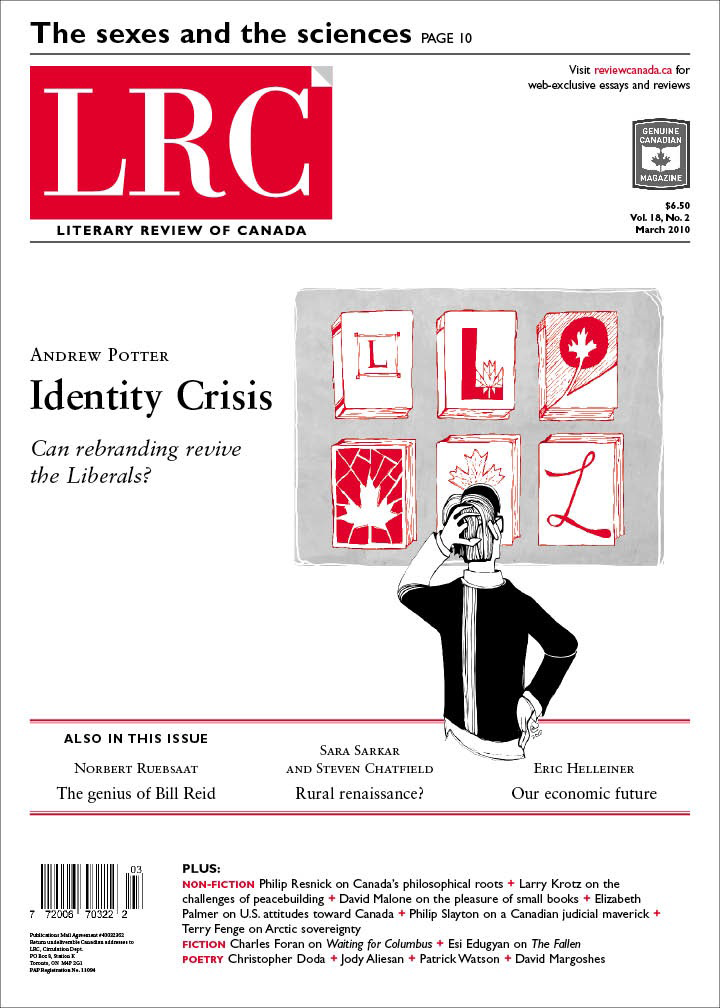
Extreme talkfests are a Canadian specialty, and at the end of March the confused Liberal Party of Canada will be holding one in Montreal. To help the delegates focus their minds, the LRC has commissioned Andrew Potter of Maclean’s to suggest ways through the party’s ongoing “Identity Crisis.” Potter reminds us that the Liberals have been here before – three times, in fact – and have always followed their soul-searching years in the wilderness with an immediate return to power. Can they do it again?

When women began swelling the ranks of scientists and engineers in the 1980s and 90s, we thought the trend would just continue. But since 2003, the number of women involved in science in this country has been steadily declining, and Monique Frize set out to find out why in her book, The Bold and the Brave: A History of Women in Science and Engineering. Our reviewer, Sheilla Jones, has done her own hard time in the physics lab before leaving to become a science writer instead, thus adding to the statistics.

We are all familiar with the iconic Haida images that the late West Coast artist Bill Reid sculpted in wood and gold, in argillite, ivory and bronze — images we encounter at the Canadian embassy in Washington, at Vancouver International Airport, on the backs of our $20 bills. Most Canadians, though, don’t know that Reid was also a perceptive writer about the history and culture of Haida Gwaii (the Queen Charlotte Islands). Solitary Raven: The Essential Writings of Bill Reid is the book that gathers this material together, reviewed for us this month by Norbert Ruebsaat, who has also written extensively on these subjects.

Happy reading.

Bronwyn Drainie

In the March 2010 Issue

  • Identity Crisis

    But for the Liberals, that’s not necessarily a bad thing.

    Andrew Potter
  • Words of an Artist

    A review of Solitary Raven: The Essential Writings of Bill Reid, edited by Robert Bringhurst

    Norbert Ruebsaat
  • The Sexes and the Sciences

    A review of The Bold and the Brave: A History of Women in Science and Engineering, by Monique Frize

    Sheilla Jones
  • A Country Worth Living In

    A review of Discover Canada: The Rights and Responsibilities of Citizenship, by Citizenship Canada

    Brendan de Caires
  • Progressive Fortune Telling

    A review of Beyond the Bubble: Imagining a New Canadian Economy, by James Laxer

    Eric Helleiner
  • The Anguish of Aftermath

    A review of The Fallen, by Stephen Finucan

    Esi Edugyan
  • The Scoop on Peacekeeping

    A review of Pale Blue Hope: Death and Life in Asian Peacekeeping, by Ronald Poulton

    Larry Krotz
  • American or British Liberty?

    A review of Le concept de liberté au Canada à l’époque des Révolutions atlantiques (1776–1838), by Michel Ducharme

    Philip Resnick
  • The Flat Rock Light 1997

    A poem

    Patrick Watson
  • Nothing lasts, nothing’s finished…

    A poem

    Jody Aliesan
  • Where Jesus went (for Art Slade)

    A poem

    David Margoshes
  • A Sad Effect of Tenure

    A poem

    Christopher Doda
  • The Anguish of Aftermath

    A review of The Fallen, by Stephen Finucan

    Esi Edugyan
  • Prismatic Fiction

    A review of Waiting for Columbus, by Thomas Trofimuk

    Charles Foran
  • Strange Bedfellows

    A review of Canadian Maverick: The Life and Times of Ivan C. Rand, by William Kaplan

    Philip Slayton
  • Down on the Farm

    A review of Trauma Farm: A Rebel History of Rural Life, by Brian Brett, and The War in the Country: How the Fight to Save Rural Life Will Shape our Future, by Thomas F. Pawlick

    Sara F. Sarkar and Steven P. Chatfield
  • The Race for the Arctic

    A review of Who Owns the Arctic? Understanding Sovereignty Disputes in the North, by Michael Byers

    Terry Fenge
  • In Praise of Short Books

    A review of The Forgotten Peace: Mediation at Niagara Falls, 1914, by Michael Small, and Fiscal Federalism: A Comparative Introduction, by George Anderson

    David M. Malone
  • Neglectful Disrespect

    A review of Bomb Canada: And Other Unkind Remarks in the American Media, by Chantal Allan

    Elizabeth Palmer
  • Cover art and pictures throughout the issue by Justin Chen

    Justin Chen is an illustrator based in Vancouver, British Columbia. His work has appeared in Feathertale, Ricepaper, and SubTerrain Magazine. His recent projects can be seen at flickr.com/photos/jkhc.

Letters for March 2010

  • Re: “Identity Crisis” by Andrew Potter

    I am writing in response to Andrew Potter’s article about the Liberals. I found it contradictory – rebrand the Liberals but don’t do anything new – and wrongheaded. There is a desperate need for new ideas and leadership to face the challenges of the 21st century, revitalize our politics to increase voters especially among the young, but also to put our people to work.

    In the past journalists clamoured for the Conservative and Reform parties to merge. Today they pan any notion of coalition. This is shortsighted; I urge the leaders of the Liberals, NDP and the Green Party to ignore them. When it became clear we were not going to have proportional representation, it seemed evident that some other way should be found to ensure that the majority views, which are not conservative, would be represented in government. As that has not happened, people are bored, as reflected in low voter turnouts. Issues that interest Canadians, such as the environment, are not acted on. Our role in the Afghanistan war was never debated. Any effective criticism of the government is shut down along with Parliament. So what to do!

    At the federal level, we have had a multi-party system since 1921. We have a relatively broad spectrum of ideas represented by the numerous parties, which is healthy in a democracy. We have a long tradition of political liberalism, conservatism, and the minority strain of social democracy is also about a hundred years old. So why fight it, or urge people to vote strategically for people they don’t believe in? Instead we should let voters debate politicians during campaigns, vote for what they believe in and see what happens. It likely will result in a minority government again, which would last until a new election but I think the Liberals, NDP and Greens (if they elect anyone) should form it. On issues of diplomacy, health, education, and stimulating the economy with green industries to combat climate change, they could find plenty of room to cooperate. In Europe such governments are formed frequently as in the recent election in Germany. The nature of coalitions changes but they keep the larger parties in power while giving minority parties some input, which makes for more representative policies.

    If politicians thought about the public interest, instead of their own or their parties’ interests exclusively, they might learn to cooperate constructively. In terms of personalities, there may even be a good fit. Michael Ignatieff is a bit indecisive and politically inexperienced, but he is capable intellectually of seeing the big picture and this country needs a vision for the future. Jack Layton is less inspiring when it comes to “the big picture” but he is very good on furthering specific programs as a result of his experience in Toronto politics. If someone from the Green Party is elected next time, they would bring much needed expertise on environmental issues to the table.

    My eyes glaze over reading about the “same old” issues in the “same old” budgets put out by the same old overwhelmingly male, white, well-heeled politicians. I wonder what are the opposition parties waiting for? It might spark some new initiatives and we might get some candidates that reflect our population mix, including women and different ethnic and racial groups.

    As the Olympics proved, huge amounts of energy and talent exist, particularly among the young. Politicians are a turn-off because they are self-interested, lack new ideas, don’t reach out to voters enough, and have their ideas packaged for the population by equally conventional, complacent journalists. That does not mean there are not new ideas, new people, and new political strategies out there to move us forward in a new global economy, and get us back to showing some progressive leadership on environmental and social issues. Let us begin.

    Laurel MacDowell
    University of Toronto

  • Re: “The Sexes and the Sciences” by Sheilla Jones

    First, I wish to thank Sheilla Jones for the in-depth and insightful review of my book, The Bold and the Brave: A History of Women in Science and Engineering. The comments on the historical parts summarize well the arguments that show the cyclical nature of women’s access to education. Concerning the contemporary times, Jones mentions that “it is quite difficult to obtain up-to-date data from universities, so that much of what Frize is analyzing is already out of date.” Jones says this makes it difficult to arrive at a definitive conclusion on why women’s enrolment is declining in science and engineering. However, the statistics are also part of the history and show trends that will be important to look at decades from now. Most of the tables have been placed in appendices not to distract too much from the discourse.

    Through her personal experience, Jones reveals a major problem that young women face when choosing a scientific career. She notes: “I did not have a single woman professor, lecturer or lab instructor from the time I started physics until I graduated with a master’s degree.” In the book, I relate my own personal story of being a lone female in a world of men, where I felt isolated, different and sometimes out of place. There are two chapters on solutions to this problem: how to get more female role models in the classrooms and how to get more in these careers.

    It is interesting that several of the comments made by a well-known activist for women in science and engineering, Dr. Margaret-Ann Armour, are clearly stated in the book, which reinforces their pertinence for an audience interested in this topic. It is also interesting that both Armour and I blame the culture in science and engineering as a critical factor that deters women from enrolling in these programs. Not to be overlooked is Armour’s statement that “masculine characteristics are valued more highly than feminine ones.” This is the crux of the matter and stressed throughout the book; the value of women’s work will become a reality when scientists and engineers respect the difference that women may bring to this ­enterprise.

    Monique Frize
    Ottawa, Ontario

  • Re: “Down on the Farm” by Sara F. Sarkar and Steven P. Chatfield

    As a libertarian, I have nothing against people enjoying the rural lifestyle, seeking self-satisfaction above profits and promoting what they enjoy and believe to be true—as long as they don’t impose their values and beliefs upon others through coercion (taxation, regulation, mandatory “buy local” policies, etc.). Personally, I couldn’t wait to get out of this lifestyle (my parents produced maple syrup and apples as sideline activities and I had chopped more wood by the time I was twelve than most people will in a lifetime). Some of us, and I suspect most human beings if you look at rural exodus historically, just feel more at home in cities and would rather enjoy the best the world has to offer, especially if this is better for both the economy and the environment as I believe to be the case.

    Pierre Desrochers
    Toronto, Ontario

  • Re: “Down on the Farm” by Sara F. Sarkar and Steven P. Chatfield

    Reviewers Sarkar and Chatfield are right to award Thomas F. Pawlick’s The War in the Country: How the Fight to Save Rural Life Will Shape Our Future and Brian Brett’s Trauma Farm: A Rebel History of Rural Life high marks for giving us compelling stories about farming and rural life. These stories are keepers and reminders of the countryside that was at the turn of the 21st ­century.

    However, Pawlick’s attempt fails to turn his collection of stories from his own rural community into a call to action and a guide to save this rural way of life. His analysis of the causes that underlie his war is too shallow. I misunderstood these diverse clashes in the countryside until I read Jane Jacobs’s Cities and the Wealth of Nations years ago, particularly her musings about the countryside and its relationship to cities. She did not refer to the wide-open spaces beyond our city limits as countryside, rural, exurban or even country. Her term was “hinterland.” I reread that part of her book many times—eventually accepting her reasoning.

    The economy of the hinterland depends totally on wealth generation in the cities to which the countryside is connected—the stronger the connection, the more robust the rural economy. I don’t like this, but I accept it. And not far behind economics is culture: the stronger the connection, the more vital the rural culture.

    Pawlick wants an independent economic and cultural future for the countryside. For this reason, he includes a to-do list and introduces the reader to organizations with agendas that try to minimize the urban influence in the countryside. Good information—but only if you believe that the countryside can be strong without the economic and cultural support of the city. I don’t.

    Both Brett and Pawlick hold out a false hope if they urge countryside folk to expend their resources on an independent rural future. There is room for some managing of the all-pervasive urban economic and cultural juggernaut. Broadly based alliances of rural interests are the best hope but even these are likely to be dependent on their connections to cities to be successful.

    Elbert van Donkersgoed
    Plumbline Locavore News

The LRC welcomes letters. We reserve the right to publish such letters and edit them for length, clarity and accuracy. E-mail editor[at]lrcreview[dot]com.

Online Originals